


A conversation with the curators of OBTUSE (°)
- Jan 2
- 4 min read
Updated: Feb 3

Read Review Here
Khaya: Across the practices of the artists featured, there appears to be a shared willingness to abandon realism (e.g., Irene Pouliassi, Lola Dupre, Yuma Radne), fixed meaning (Abigail Norris), or stable form (Juntao Gao). To name a few. They also seem to resist legibility or immediate comprehension.( I will clarify this in my review) Was this alignment something you consciously considered during the curatorial process, or did it emerge more organically through conversations and the development of the programme?
Selin & Moco: That alignment wasn’t something we set out to engineer in a prescriptive way. Our curatorial process usually begins less with meaning and more with sensation. We respond first to how a work feels, whether it carries a sense of freshness, urgency, or an unfamiliar perspective, rather than to what it might immediately signify or represent. Meaning, for us, comes later. What matters initially is encountering something that resists familiarity: a gesture, material decision, or conceptual turn that feels unresolved, or newly articulated by the artist themselves. Many of the artists we worked with are already well established in their practices, not in terms of recognition, but in the sense that their work is deeply considered and fully formed. What mattered to us was that the work was not reiterating existing visual or conceptual languages, but instead proposing a position we hadn’t encountered before. So while the shared resistance to realism, fixed meaning, or stable form became visible across the exhibition, it emerged organically through conversation and proximity rather than as a thematic framework imposed from above. So we could say that alignment happened through intuition, dialogue, and a shared interest in practices that refuse easy legibility, works that ask to be felt, encountered, and stayed with before they are understood.

“Rather than inviting audiences to move quickly from piece to piece, we wanted to encourage forms of attention that are slower, more embodied, and more relational."
K: The curatorial text places strong emphasis on atmosphere and states of presence rather than on objects alone. How do you think about atmosphere as a curatorial material, and what kinds of attention or modes of engagement were you hoping the exhibition might invite from its audience?
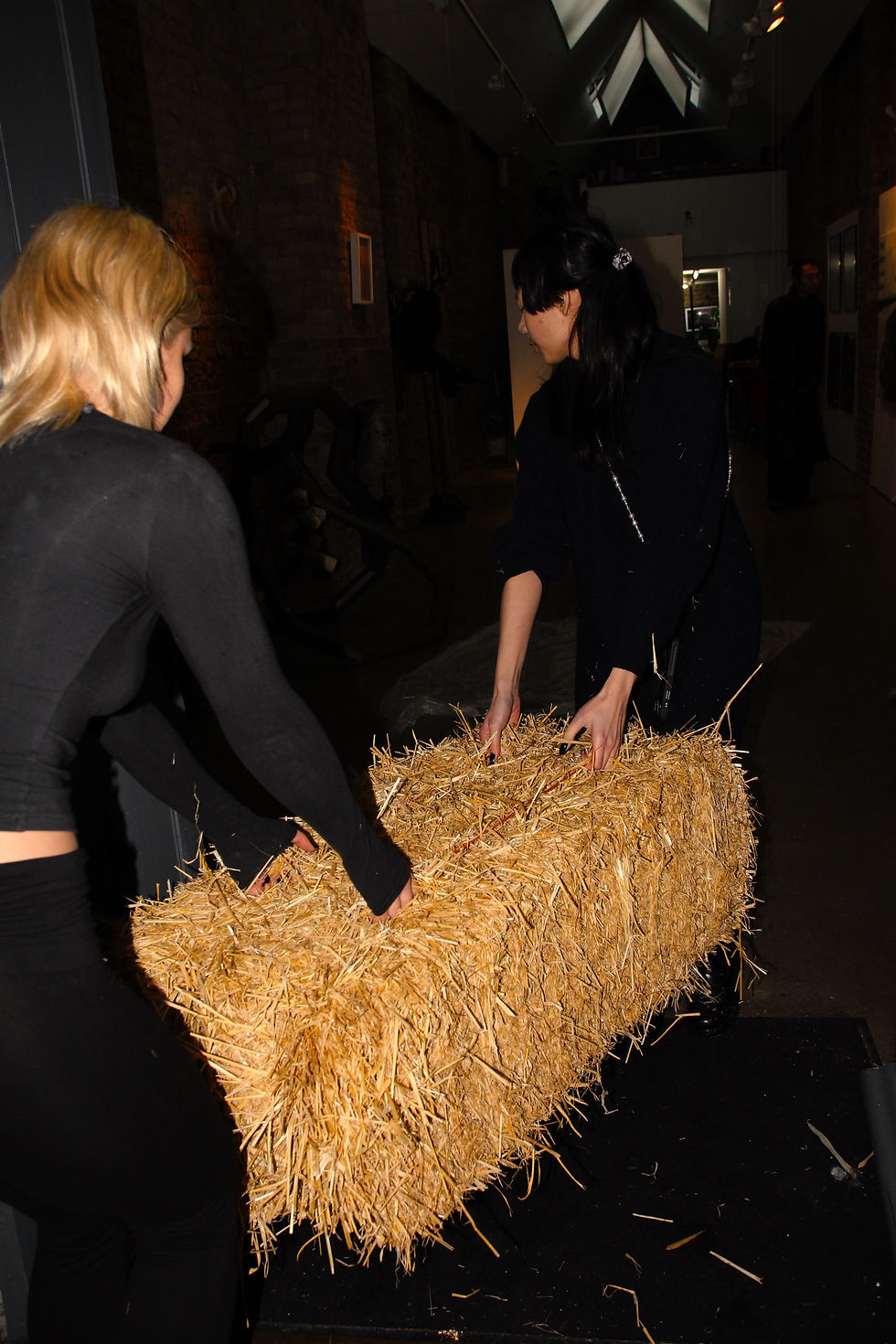
S & M: From the outset, we were interested in moving away from the idea of the exhibition as a static presentation of objects. Coming from both a formal curatorial training and an experience within commercial exhibition spaces, we wanted to use this project to test another mode, one where the exhibition functions as an experience rather than a viewing exercise. Atmosphere, for us, is not supplementary; it is a curatorial material in its own right. With OBTUSE (°), we were conscious of creating a situation that unfolds over time and through encounters. This is why the programme extended beyond visual works to include live performance and food interventions across both days. These elements weren’t conceived as additions or embellishments, but as integral components that activated the space and shifted how the works were encountered. Rather than inviting audiences to move quickly from piece to piece, we wanted to encourage forms of attention that are slower, more embodied, and more relational. The aim was not for visitors to “consume” the exhibition, but to inhabit it, to linger, to listen, to experience moments of co-presence where meaning emerges through atmosphere, duration, and shared experience rather than immediate interpretation.

K: I’m interested in how platforms like Obtuse Archive are emerging within London’s contemporary art landscape, alongside initiatives such as Display Fever or Teaspoon Projects. How do you see Obtuse’s approach or philosophy in relation to other experimental platforms, and what do you think this signals about current curatorial or artistic practices?
S & M: What initially shaped Obtuse Archive was moving between very different contexts - alternative, experimental ways of working, and more commercial structures - and noticing a shared limitation across the current media and cultural landscape. So much attention is driven by hype and repetition: something appears, gains traction, and is quickly reproduced across platforms until it loses depth. Visibility often replaces consideration. Against this, Obtuse Archive emerged as a space for working more carefully and more expansively. We describe it as a loose structure, not because it is undefined, but because it is intentionally open to multiple forms. Exhibition-making is a key part of the project, and we plan to continue developing exhibitions in different formats over the coming years - pushing how exhibitions might function through performance, sound, and other time-based practices, rather than treating them as static displays. At the same time, the archive is equally central. Through conversations, visual essays, documentation, and future plans such as an online gallery and the production of new works, we’re interested in building continuity rather than isolated moments. These different strands operate together, not as separate projects, but as parts of a wider ecosystem. What distinguishes Obtuse, for us, is this commitment to thinking beyond exhibition-making alone. The exhibition is not the endpoint, but one moment within a longer process of accumulation, reflection, and exchange. In relation to other experimental platforms, this approach reflects a broader shift in contemporary practice: a desire for structures that allow work to develop over time, that balance experimentation with sustainability, and that prioritize attention and care over immediacy or spectacle.


Comments